

How To Make A Window Cornice Board
How to Build Window Cornices
Updated: Jan. 17, 2019
Custom-build your own window cornices for ane-fourth the price of store-bought
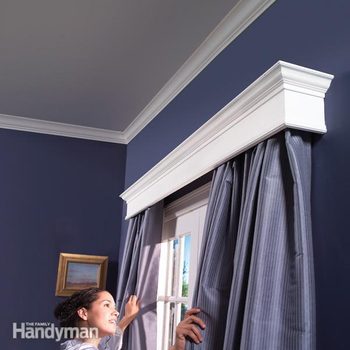
Want to give a dreary room a dramatic facelift? Adding window or door cornices will bring freshness and way to any room decor. They'll hide ugly drapery rods and add together a touch of custom-fabricated detailing that makes an ordinary window or patio door expect like something special. The peak of the cornice can even serve every bit a brandish shelf for art or collectibles. Cornices are surprisingly easy to build, fifty-fifty the elegant ones you come across in home magazines. Using off-the-shelf trim from the home middle and a compound miter saw, anyone with elementary carpentry skills can create a beautiful window or door cornice in just a few hours. Read on and we'll testify you how to select the materials, get together the parts and attach the cornice to the wall. We'll also share pattern tips to assistance yous match a cornice style to your dwelling house decor. Search online for cornice suppliers and you'll see that you lot can save huge money by building your own.
You lot might also like: TBD
- Time
- Complexity
- Price
- Multiple Days
- Intermediate
- $51–100
Design the cornice to fit your home
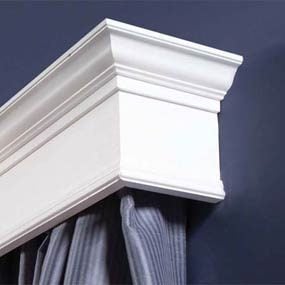
Finished cornice close-up
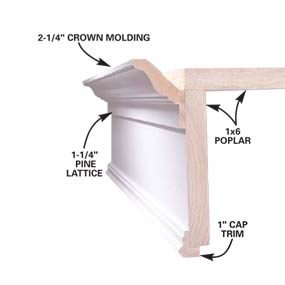
Cornice cross-section and parts
Design elements within your home should dictate the wood blazon, molding mode and finish that you lot select. Depending on the design, the top either overlaps the sides, sometimes with a routed edge, or is nailed to the height or inside of the box and doesn't show from beneath. The tops are best fabricated from 1x4s, 1x6s or 1x8s. There'south no demand to cut the tops to width if yous choose the right combination of meridian way and board size. The example nosotros prove is a 1×6 nailed on height of the box, which gives an overall inside depth of 4-3/4 in. For the same await but with a shallower box, you could also nail a 1×4 inside the box flush with the top for a depth of 3-one/ii in. Cull whichever method information technology takes to clear your curtains.
Other Cornice Design Options
A Cornices design options are nigh endless. If yous're having trouble choosing, here's a tip. Buy curt lengths of different types of trim along with some cheap 1x4s and 1x6s. Cut everything to 1-ft. lengths and mock up several different combinations. Just eject a lilliputian wood glue on the pieces and clamp them together for about 10 minutes. Hold the cornice mock-ups over the opening to get a experience for the concluding look.
Select materials and collect key tools
If you lot programme to paint your cornices, poplar and aspen are good choices for the box materials. They're stable and cheap, and the grain won't show through paint. Pine and basswood moldings are usually the to the lowest degree expensive choices for paintable trim.
If you want stained or natural wood cornices, expect for oak, mahogany, carmine, maple and others at dwelling centers. The biggest problem is finding hardwood moldings other than oak. You may take to special-club them or observe a specialty millwork supplier online.
The best tool for cut miters on wide boards (1x6s) is either a 10-in. compound miter saw or a sliding chemical compound saw. Standard compound saws work like typical miter saws, simply the motor and bract tip sideways, making them capable of cutting bevels. A sliding compound miter saw cuts compound angles too, but the motor and blade slide on tracks so information technology can handle wider stock.
Be sure to apply a sharp finish-cut bract in either i. Prices for standard compound miter saws are quite low, or you can hire one.
Yous can predrill and mitt-blast near of the project, but an air-powered brad nailer with i and1-1/2-in. brads makes the job much easier. Many are cheap and well worth the toll. Or yous tin can rent one. (Rent ane of the special airless ones and you'll save the toll of renting a compressor.) But for the coin, compound miter saws and brad nailers are far likewise useful and far as well fun not to own yourself.
Get together the bones box
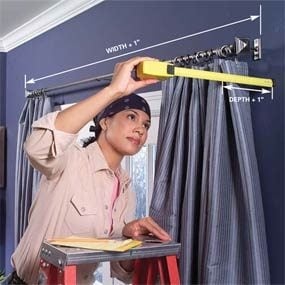
Photo 1: Measure carefully
Measure the outside width and depth of defunction, curtain rods or shades that you want to comprehend and their distances from the wall. Add ane-in. to decide the within box dimensions.
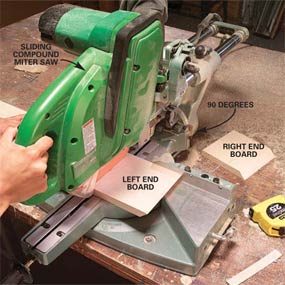
Photo ii: Cut the boards
Cutting 45-degree bevels on both ends of the front end board and on i stop of each end lath. Then reset the saw to ninety-degrees and cut the end boards to length.
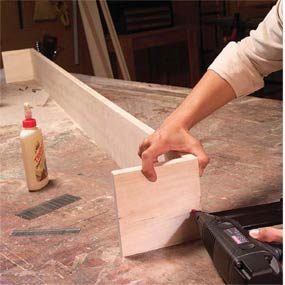
Photo 3: Join the boards
Smear wood mucilage on the miters and tack the joint together with half dozen i-in. brads, three from each side.

Photo iv: Attach the top
Cutting the top board to length to fit flush with the front and sides of the box (depending on the design). Mucilage and nail the tiptop to the box frame with i-1/ii in. brads spaced every 6-in.
Every forest cornice begins the same way, with cutting and assembling the three-sided, lidded box (Photos 2 – 4). And so you add the trim of your choice (Photos 5 – 9) and finish the cornice (Photo 11). The cornice is and then fix for mounting on the wall by screwing it to a i×2 that's screwed to the wall in a higher place the opening (Photos 12 – fourteen).
Begin past measuring the pall and mantle rod for length, depth and width (Photo 1). Measure with the defunction open so you take into account their thickness when bunched. Add an inch or so to the depth and the width of the curtain rod to make sure the cornices will comprehend everything.
Miter the ends and forepart box pieces first. It's easiest to foursquare up the lath, so tilt the miter saw to cut a 45-degree bevel for the first end piece and and so square it upwards to cut the second end (Photo ii). The mitered corners are glued and nailed together with 1-in. brads. Measure the assembly to determine the exact length for the top.
Utilize the trim
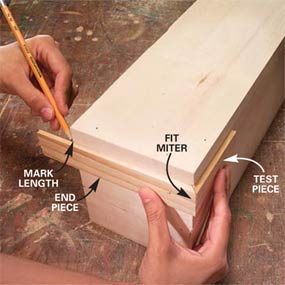
Photo five: Fit the trim
Using a brusk test piece, fit the end piece and mark and cut it to fit. Use the test piece to accurately position the trim while yous glue and nail it to the box. Cut the miter on the long front slice of trim, fit information technology to the first slice, marker its length, then cut and fasten it. Repeat the steps for the other terminate.

Photo half dozen: Cut the end pieces
Cut the ii crown molding cease pieces i-in. longer than needed with opposite 45-degree angles on i finish of each piece (you're cutting a right and a left corner).
Tip: Build up short fences to support crown moldings while cutting by screwing 1×4 boards to the saw fence through the predrilled holes in the fence (shown higher up).
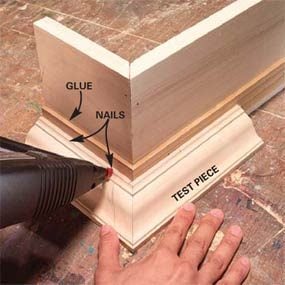
Photo 7: Attach the crown molding
Flip the box upside downwards and prop the crown molding terminate slice against the box. Use the other end as a test slice to line up the miters. Mark and cut the piece to length. Smear a piffling glue along the bottom and tack information technology to the cornices with a couple of 1-in. brads.
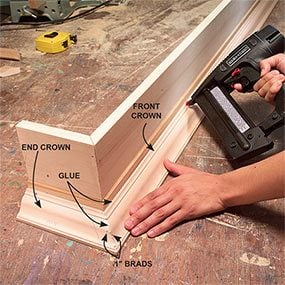
Photo 8: Finish installing the crown molding
Exam-fit, marking and cut the forepart piece of crown molding to length. Glue and boom the miters together, and so smash the molding to the cornice box. Cutting and install the last end piece of crown molding.
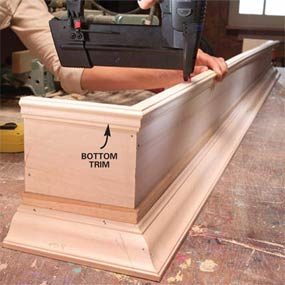
Photo nine: Install the bottom trim
Cut, fit, gum and nail the lesser piece of trim to the box using the same techniques you used with the crown molding.
When mitering the trim for the box, always start by first cutting and mounting an end trim piece, then the long front trim and finally the other finish. That way, you'll exist able to check fits and get crisp miters at each corner. Fit each miter, so scribe the length of each piece rather than measuring (Photo 5). Information technology'southward faster and much more accurate. It's best to cut pieces only a tad long and so y'all can shave them down until they fit perfectly. If you' re new to woodworking, it' south nice to have a helper past your side to hold the miters together while y'all're scribing lengths or fastening parts.
The fox to cutting perfect crown molding miters is to rest the molding upside downwardly and against the bed and fence while cutting the 45-caste angles (Photo half dozen). If y'all cut wide crown molding, you may have to extend the fence height by screwing a length of 1×4 to the miter saw fence through the holes in the dorsum. Think that the long bespeak of the miter is always the height edge. That'll help you recollect which style to bending the saw before cut. To farther eliminate the costly mistake of miscutting, an bending, depict a light line while y'all're fitting the piece to point the proper angle (Photo 6).
Polish and finish cornices
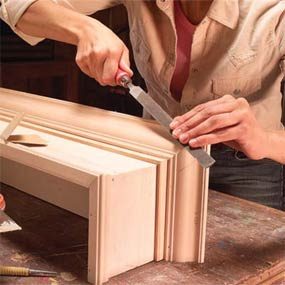
Photo 10: Smooth out the profiles
Fill nail holes and any miter gaps in joints with woods filler. Sand excess wood filler and file miters as necessary to remove any woods fibers or smooth out inconsistencies in profiles.
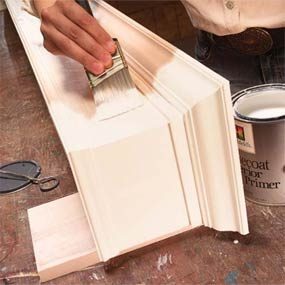
Photo xi: Prime the woods
Prime the forest and lightly sand it with 150-grit sandpaper before applying your choice of pigment.
Fill nail holes and prime earlier painting. If your cornices have elaborate details similar dentil blocking, you lot'll get better results with several lite coats of spray paint instead of brushing. Finish highly detailed natural and stained wood with spray lacquer, shellac or polyurethane.
Prepaint the i×ii cornice ledger to match the wall before you lot put information technology upward if you lot think it'll show afterwards the window covering is in place (Photo 13).
Mountain the cornice over the window
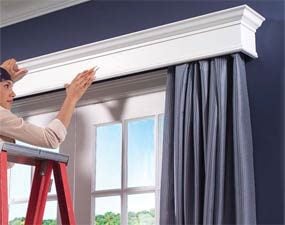
Photo 12: Center the cornice
Center the cornice over the opening at the height that best covers the curtain rod and curtain. Then reach underneath and marking the bottom. Take down the cornice and extend the mark with a 4-ft. level.
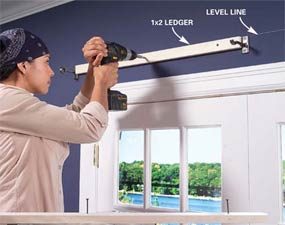
Photo 13: Install the ledger
Cut a 1×2 to fit between the curtain rod brackets. Screw it through the drywall into the framing with 2-1/two-in. screws spaced most every foot.
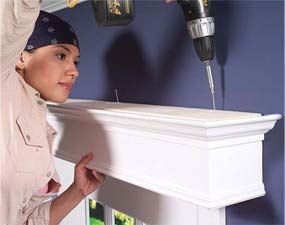
Photo fourteen: Drill pilot holes
Predrill 1/eight-in. pilot holes spaced near every foot in the height of the cornice three/four in. from the back border. Angle the holes slightly toward the wall. Concur the cornice tight to the wall and run 2-in. screws into the 1×2.
Required Tools for this Project
Have the necessary tools for this DIY project lined upwards before you start—y'all'll save fourth dimension and frustration.
Required Materials for this Projection
Avoid last-minute shopping trips by having all your materials ready ahead of time. Here'due south a listing.
Originally Published: December 19, 2018
Source: https://www.familyhandyman.com/project/how-to-build-window-cornices/
Posted by: rosadoanxich.blogspot.com
0 Response to "How To Make A Window Cornice Board"
Post a Comment