

How Do You Clean The Microscope Before Putting It Away? Put The Steps In Order.
Microscope Maintenance
Routine optical and mechanical maintenance of compound microscopes can ensure that your microscope works well for years. The microscope maintenance information provided below is not meant to replace whatever specific directions included with your microscope and periodic microscope servicing by a qualified microscope technician is recommended. Chemical compound microscopes should mostly exist serviced after almost 200 hours of employ. For nigh schools, this would be about every iii years, mayhap more than frequent if the microscope is used multiple times each 24-hour interval. There is a not bad commodity here about how to avoid microscope repairs.
Microscope Handling and Storage
Most microscope bug occur as a result of improper handling. When carrying the microscope, always concur it by the base and the metal back up arm. Do not choice information technology up past grabbing the stage, every bit this tin can cause mis-alignment for the mechanical stage. If yous volition exist transporting the microscope frequently from one location to some other you might consider purchasing a microscope conveying instance.
When the microscope is not in use keep it covered with the grit cover. This lonely will extend the life of your microscope. Even if the microscope is stored inside a cabinet, you should yet embrace it with the dust comprehend. Exercise not store a microscope without whatever eyepieces, fifty-fifty if it is covered. This can allow dust to collect within the eye tubes, which can be difficult to clean. If the microscope eyepieces must be removed, simply embrace the tubes with caps or a plastic bag with a rubber band around the eye tube.
If you are using immersion oil the high ability objective lens (unremarkably 100x) and the lens of the condenser should be thoroughly cleaned before storing. After using the microscope, turn off the illuminator and look for it to cool for several minutes earlier putting it away. By allowing the bulb to cool you will extend its life. Also, make sure you do not store your microscope in an area that has corrosive chemic fumes that can destroy lenses or metal parts.
Cleaning Microscope Eyepiece Lenses
Microscope lenses can easily exist scratched and should be treated with dandy care. Never use sharp instruments or anything abrasive to make clean the microscope lens. To clean the microscope eyepiece or the microscope objective lens, moisten lens newspaper with lens cleaning solution and make clean the lens with a circular motion. Yous can dry the lens with a clean, dry slice of lens paper and when you are finished use an aspirator to remove any lingering dirt or particles.
To determine if your microscope eyepieces need cleaning, loosen the small-scale set screw for the eyepiece (if there is one) and rotate the eyepiece in a circular motion while looking through the microscope. If there is a dust particle that rotates as you rotate the eyepiece, remove the eyepiece from the microscope and make clean both sides of the lens with lens paper. If you need to use any liquid for cleaning, distilled h2o is recommended. Information technology is not recommended that y'all accept the eyepiece apart, as in that location are more often than not multiple lenses in the eyepiece and they can be difficult to put dorsum together in the correct order.
Cleaning Objectives
In order to determine which of your objective lenses need cleaning, accept a clean blank glass slide and put it under your microscope. In one case the microscope is focused you should exist able to move the slide and make up one's mind if the visible dust is moving with the slide or staying in the aforementioned identify (which ways the dust is on the objective lens).
When using immersion oil for microscopy, the oil should always be cleaned from microscope objective lenses immediately later utilise. This tin be washed with a kimwipe of slice of lens newspaper, no cleaning solutions are needed. Occasionally dust may build upwards on the lightly oiled surface so if you wish to completely remove the oil so you must use an oil soluble solvent. For the Cargille Type A or B immersion oil that we sell, you tin use Naptha, Xylene, or turpentine (use very small-scale amounts on the kimwipe). Do non use water, booze or acetone as the oil is insoluble to these solvents. To remove other oily substances, we recommend using the detergent called Wisk and prepare a solution of 1 part Wisk to 100 parts h2o.
If immersion oil was not cleaned off an objective afterwards utilise and has hardened on the objective, moisten a piece of lens newspaper with a small amount of distilled water and hold it against the lens for a few seconds to deliquesce the oil. If that does not work, try alcohol. Isopropyl booze is one of the all-time solvents simply information technology must be at to the lowest degree 90%+ pure (practice not use rubbing alcohol, xxx% water). Everclear which is grain booze (you lot must exist 21!) tin can also be used merely it doesn't practise as well in dissolving crud. If you take something similar Balsam stuck on the lens, you must resort to a stronger solvent like Acetone or Xylene. Acetone should never be put on plastic parts, every bit it will deliquesce most paints and plastic. Later on using solvents be sure to make clean the objective once again with standard distilled water to ensure that you have removed all the solvents from the microscope objective.
Mechanical Maintenance
Each microscope should come with a user'southward manual. Ever consult this user's manual earlier making any adjustments to your microscope. Never over-tighten or utilise force when performing whatsoever maintenance on your microscope. This tin damage metal parts in the microscope.
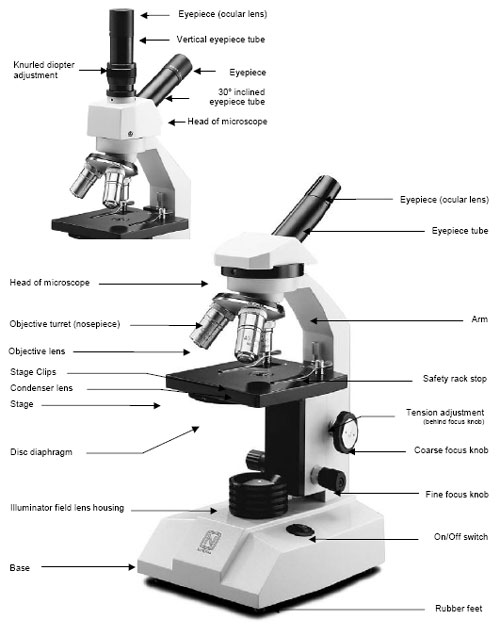
Microscope Diagram Nosepiece Adjustment
The microscope nosepiece can sometimes become besides loose or tight. Generally there is an adjustment mechanism on the nosepiece. A simple loosening or tightening of the slot-headed screw in the heart of the nosepiece will unremarkably solve the problem. Cheque your user's manual for consummate instructions.
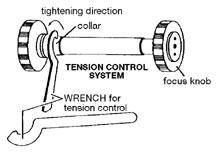
 Adjusting the Focus Knob
You can accommodate tension of the fine and coarse focusing knobs. Some microscopes are adapted by turning the knobs on each side of the microscope in opposite directions. Other microscopes will have adjustable collars on the shaft and require the use of special wrenches to make adjustments (these usually come with the microscope when purchased). Moving the collars out usually provides more tension.
Lubricating Surfaces
On an annual basis moving parts on the microscope should be cleaned and lubricated. Make clean grease and dirt from sliding surfaces using a clean fabric. Apply a very thin layer of lithium-based grease to the sliding surfaces. Do non grease the teeth of the rack and pinion gears. After lubricating, if the fibroid adjustment moves too freely, adjust the tension knob as described above.
Replacing Bulbs
Microscope bulb replacement instructions can exist found in the microscope instruction manual. Exist certain to utilise the correct replacement bulb. Always permit the bulb to cool before replacing it. Avoid touching the glass of the bulb with your bare hands, as fingerprints and particles of dust left on the bulb tin burn into the bulb and reduce the life of the bulb as well as the quality of the calorie-free produced past the bulb. LED light bulbs tend to terminal the longest, mostly 100,000 hours. In comparing, tungsten bulbs generally will not last longer than 100 hours.

Source: https://www.microscopeworld.com/t-microscope_maintenance.aspx
Posted by: rosadoanxich.blogspot.com
0 Response to "How Do You Clean The Microscope Before Putting It Away? Put The Steps In Order."
Post a Comment