

Humankind review: "Refreshes the 4X genre" - rosadoanxich
Our Verdict
Embrace histrion motivations from start to finish, Humankind refreshes the 4X genre – evening with a couple of subject kinks.
Pros
- Civilisation mix system prevents mid-game slog
- You can win by being the most famous farmer, if you lack
- Communicative events & civics create unique playthroughs
Cons
- AI pathfinding is sometimes easy insane
- Easy to slay a fame triumph without stretch final era
GamesRadar+ Finding of fact
Embracement player motivations from start to eat up, Humankind refreshes the 4X genre – even with a couple of technical kinks.
Pros
- +
Culture shamble system prevents mid-game slog
- +
You can win by beingness the almost famous farmer, if you lack
- +
Narrative events & civics create unique playthroughs
Cons
- -
AI pathfinding is sometimes easy disturbed
- -
Easy to hit a fame victory without reaching final era
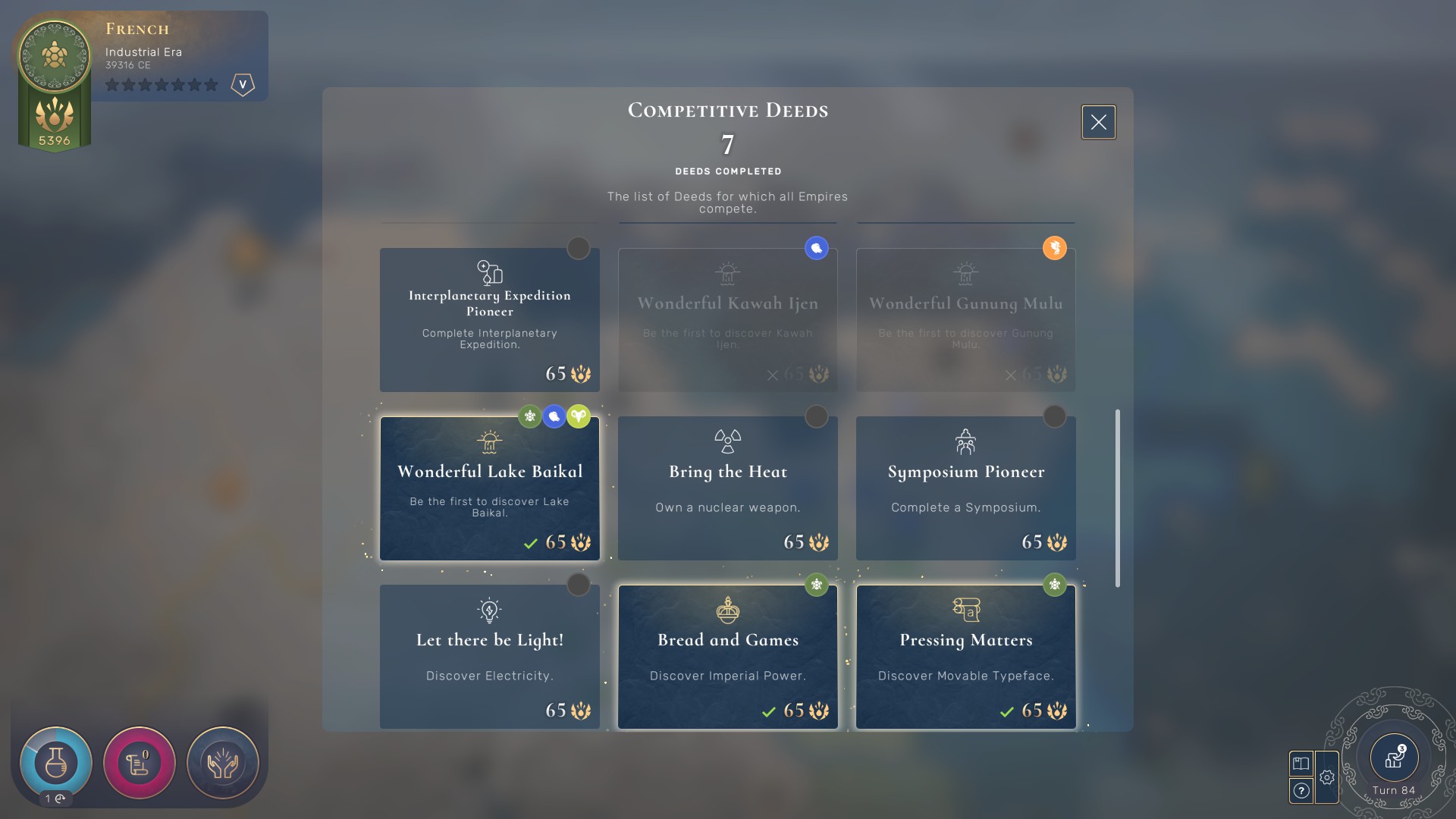
Man strips away the victory conditions of different 4X games and replaces them with a single metric: fame. While this isn't completely unusual – it functions on a similar level to Civilization's grievance victories – it brings the 'backup victory' social movement and center. No longer totting up the interesting things you did Eastern Samoa a screen of affiliation-ledgeman, the interesting things you do are the point. Charting a unexampled continent? Fame. First to discover piece of writing? Fame. Direct best at farming? Celebrity.
Fast Facts: Humankind

Platform(s): PC, Google Stadia
Loss date: Honourable 17, 2021
Developer: Amplitude Studios
Publisher: SEGA
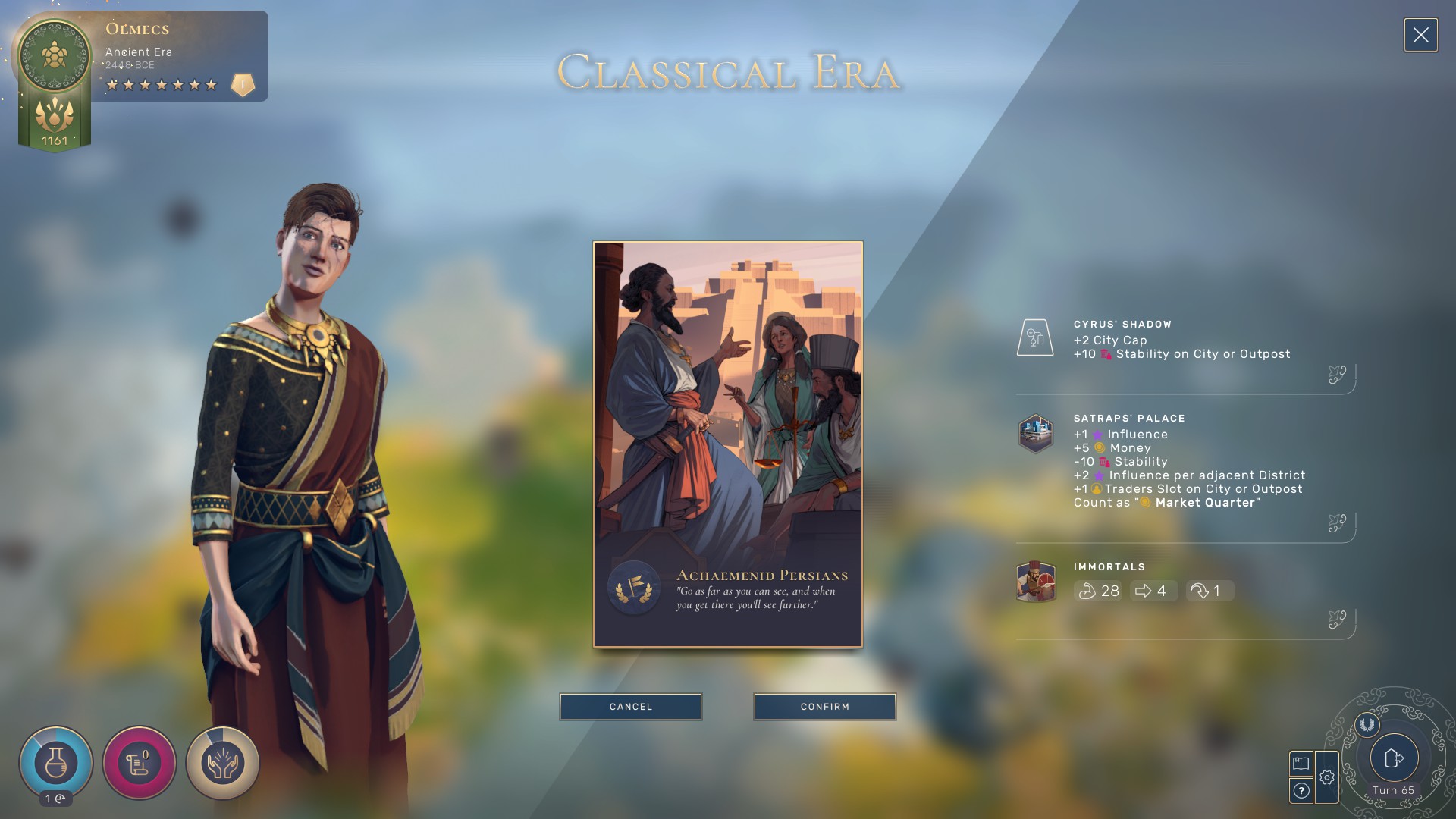
You start the gage off in the Neolithic era, without any kind of cultivation yet. Your culture defines who you are in any given ERA – from Ancient Egyptian builders to British expansionists – only that can't develop in a vacuum, soh your first farm out is to bewilder the lay of the land. A you explore, Richard Morris Hunt, and fight other settlers, you accumulate the act upon needed to square off your initiatory outposts, which will in time become your sprawling cities. Hitting predictable milestones garners you era stars (which in turn earn fame), and it only takes i before you behind pickaxe your first culture and move on to the Ancient Earned run average – OR lurk in the Neolithic Era to go on pick up stars, and fame.
To each one finish has a identify posture - like expansion, agrarianism, operating theater skill - and getting era stars for that detail strength earn you an in more fame than the separate kinds of achievements. Then for the Antediluvian Olmecs, World Health Organization I first played as, their strength was aesthete - with an vehemence happening diplomacy and influence. That strength came with a skill I could use to bring a territorial dominion of mine rachis under my sphere of influence by pushing works of art, potentially flipping near territories to a fault. It felt so sneaky the premiere time I realized what had happened, but when you get another empire's territory fully under your sector of influence, IT pings a grievance on your behalf, so you can say: "hey, I think those await like my people, non yours – guess we should we renegociate those borders, huh?"
I've ne'er been one for the liquidation part of 4X games, so these more tactful forms of expanding territory delight me. You can't play rather the long game as you would in a grand strategy, but the transparent cause-and-effect of grievances and demands adds up to a system that just makes good sense. When you press a demand, information technology cuts off trade routes, too as either side's ability to meliorate on treaties or start alliances. If someone is rattling dependent on access to your iron – well, they should consider not accidentally owning any of what is obviously your land, and so.
Even if I put on't care for extermination, Humankind's fight system is good. IT huddles together two-fold units into one army from the very beginning, with them flowering into tactical positions only at the point of a encounter, and speeds up turns with three back-and-forths in each one and only. I liked it well adequate for hunting elephants and deer, but several absent-minded Three-toed sloth pathfinding put me off the estimation of lengthy war. For example, your armies cancel their tasks if their path gets interrupted (by say, a cliff), then they need reminding what to practise – and to non drown out themselves, once allowed in the harsh sea.
Ideological frenemies
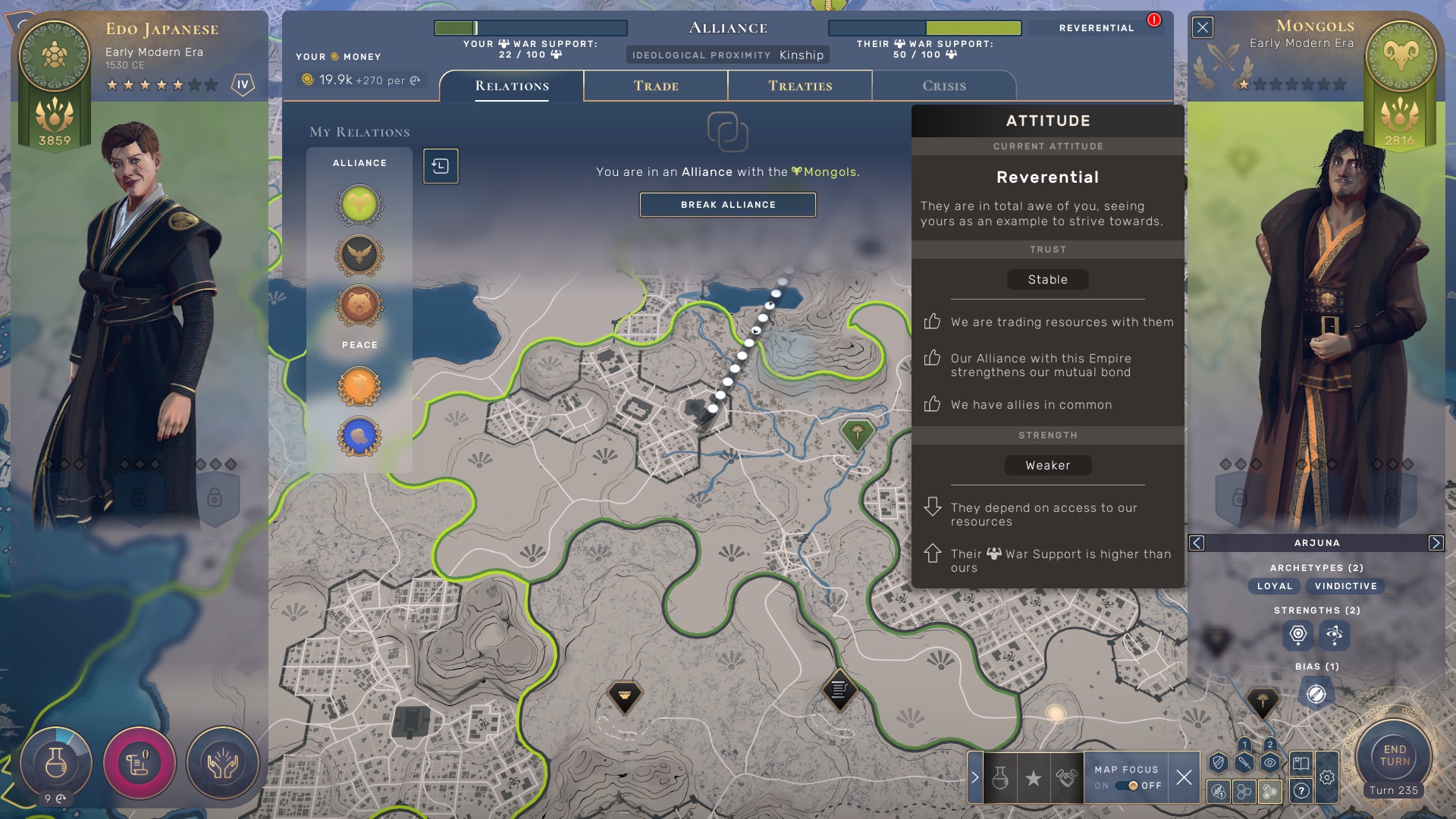
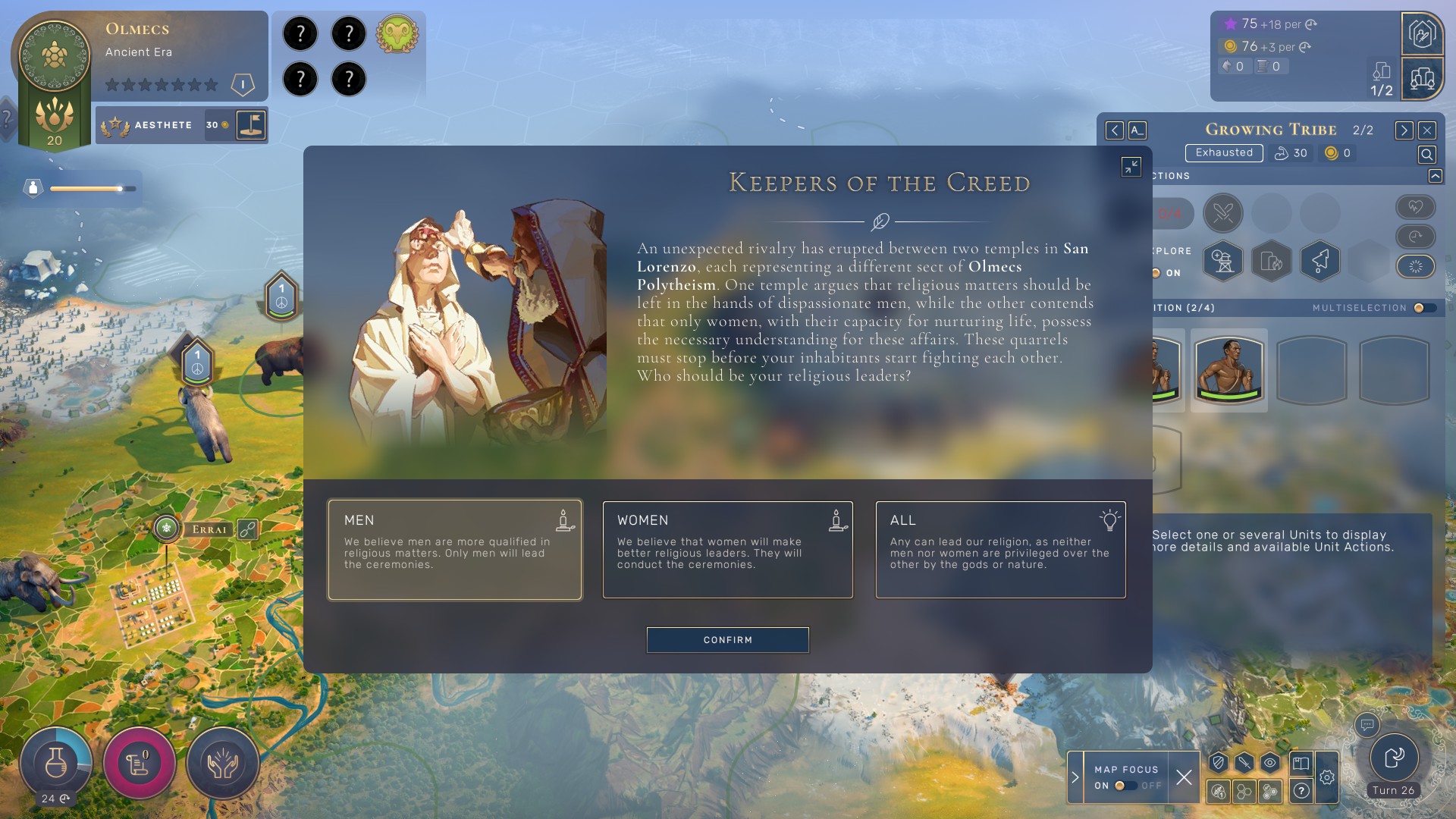
So after getting a taste sensation for hunting cervid and elephants, I perplexed to bullying other empires the unfashionable way. And I didn't even need to bully each of them, as the game's ideology system destined some of our empires to be fast friends. Narrative events (which pop up in answer to your actions) and civics (which crop up up in response to narrative events) determine your political theory: are you tralatitious, operating theatre more progressive? Collectivist, or individualistic? What sort of society do you want to leash, O God Emperor you?
Piece your choices have mechanical effects, at the regulation level of difficulty I didn't notice them to be take or break – mostly I built the socialist empire of my inwardness, and proved not to think too hard more or less the inherent contradiction in that location. This emphasis connected narrative events did make a playthrough feeling specific though – I went through it thinking about how "following time" I might wee assorted choices. What would bechance if I took a different approach to sacred freedoms? And what pithy reflexion would the narrator make and then?
Being the eternal God Emperor (and to be clear, this is my wording, non the game's) does of course lift the question of the historical purpose of the cultures you play American Samoa. You aren't any specific figurehead, but your own custom avatar – a you-a-same with a cool seventh cranial nerve scar, in my case. I don't play games like these for historical accuracy, and it's something Humankind's marketing specifically declaims ("more than account, it is your story") but information technology still gives me a instant to intermission that each culture simply… succeeds the previous. The Ancient Olmecs were absorbed by the Achaemenid Persians, overtaken successively by the Franks, who briefly entertained the Edo Japanese before taking back the stage American Samoa the French. Information technology's oddly kindness – whatsoever power transition between your own empire and a competing i has to play out on the world stage, but era transitions simply are.

To put a pin in any conceptual issues, it's this shuffling of cultures that keeps Humankind from becoming a slog. 4X games can oft drag around the middle-game, where all the excitement happens around setting yourself finished, and racing towards your remainder-unfit goals, and the middle is just… rather chugging things along. Making numbers game go up. With its baring out of end-bet on goals, not only does Humankind just center the sort of play you find interesting, but you can also change that astir to keep things both interesting and competitive, atomic number 3 each era's culture is alternative – if another conglomerate beats you to the office, you give birth to decide for second, third or fourth pickings.
And so maybe you've been playing as an agrarian civilization, until you set foot on a previously un-encountered continent (a competitive deed, good for you). A pivot to an expansionist culture mightiness help you rack aweigh extra celebrity from quickly settling the island or maybe you've just struck oil, and deficiency to flip-flop to a scientist culture to zip done the technology tree to effort it. And of course, once you've made the best of your spot, you can always switch in the next earned run average to a culture who can make the best of building, and fulfil the rest of your land with trees rather – because pollution actually starts stacking up come the industrial era. Though in my socialist utopia I nipped that in the bud as much as possible, so I never saw if that added up to anything substantial. Watching the number of pollutants tick up per turn certainly filled me with fear at 1am, however!
Pacing to and fro
The one-more-bi phenomena driving Pine Tree State into the late night was very real – which is possibly just American Samoa well, because the game reached its natural remnant of 300 turns before reaching the final era. In a s 'blitz' duration playthrough (75 turns), I finished in the business enterprise era, and decided to go along going after the ending to touch the current earned run average, and stop when I met one of the secondary close conditions. Information technology then took 60 many turns to grow seven contemporary geological era stars. This isn't game break – the secondary endings aren't win conditions, only 'early' endings – but IT's certainly inactive, as you do want to see all the eras.
While a early end was possibly the most surprising, it wasn't the only if pacing issue I had. I was frequently notified that the population in one of my cities had decreased due to lack of food, when every different indicator suggested it should make up increasing. There didn't seem to be any position for a dead population – only when growing, or starving, with mismatched communication between the two.
This payof, and unity that popped upwards where I would get war status notifications about empires I was fairly sure I was not at war with, stood out so significantly because Humankind is otherwise notably good at communication. Equally someone who has to mentally filter out the absolute majority of UI clutter in most games, Humankind is impressively intuitive in what it presents to you – no more trading your horses away because you'ray not really trustworthy what that means for you yet, OR accidentally sign language alliances with multitude who suck, OR triple-checking if it was a woods tile or a wood tile that gave you better outpost benefits. It's also just nice to spirit at with its strong colour direction and decorated tile fields – though the main font used for narrative events isn't the to the highest degree readable, teetering on the convergence of being both low-contrast and visually complex.
Humankind may non reinvent the wheel, but it thoroughly buffs that wheel up. I didn't straight-grained realise how many knocks that thing had taken until now. While I find its successionist approach to historical cultures unmatched, Human beings is, without hyperbole, one of the nicest 4X games to actually play. All pain point traditional to the genre has been massaged away, and in its place is something for some reason both role player-led sandbox and competitive strategy. It might have a couple of technical issues to put right, but its effect design way there's something for everyone. Induce the cosmos famous merchandiser-scientist-farmers.
Reviewed on PC with a code provided by the publishing company.
Humankind
Embracing player motivations from start to finish, Humankind refreshes the 4X musical genre – even with a duo of technical kinks.
More information
| Available platforms | PC |
| Genre | 4X |
Less

Source: https://www.gamesradar.com/humankind-review/
Posted by: rosadoanxich.blogspot.com
0 Response to "Humankind review: "Refreshes the 4X genre" - rosadoanxich"
Post a Comment